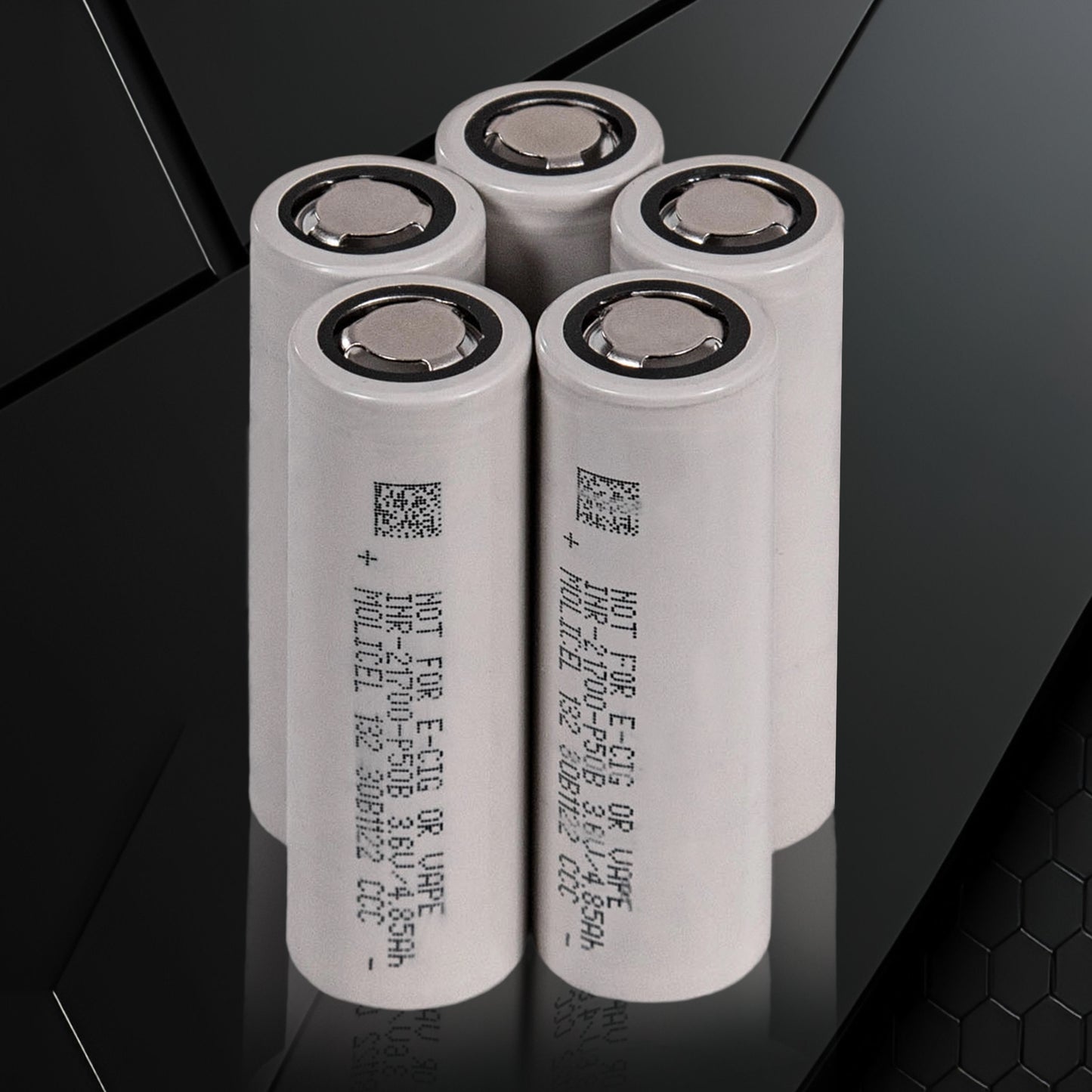
Cell Type: Lithium-ion rechargeable cylindrical cell (21700 format) Nominal Voltage: 3.6 V Typical Capacity: 5,000 mAh (5.0 Ah) Dimensions: Diameter max 21.55 mm × Height max 70.15 mm Weight: Max approx 71 g
Max Charge Voltage: 4.20 V Discharge Cut-off Voltage: 2.5 V Max Continuous Discharge Current: 60 A (80 °C cut-off) Energy Density: ~260 Wh/kg and ~714 Wh/L Operating Temperature Range: Charge: –20 °C to 60 °C; Discharge: –40 °C to 60 °C
Very High Capacity: ~5,000 mAh typical, 4,850 mAh minimum.
Ultra-High Discharge Capability: Continuous discharge up to 50 A (with spec up to 60 A temp-limited).
Low Impedance: AC ~6.5 mΩ, DC ~12.8 mΩ, enabling efficient power delivery and reduced voltage sag.
Fast Charging Support: Standard charge current 5 A, with up to 25 A allowed at higher temperature cutoff.
High Energy Density: Volumetric energy density ~714 Wh/L, gravimetric ~260 Wh/kg.
Wide Operating Temperature Range: Charge from 0 °C to 60 °C; discharge from –40 °C to 60 °C.
Robust Mechanical Design: 21700 size — 21.55 mm diameter, 70.15 mm height; weight ~71 g.
Optimized for High-Performance Applications: Designed for demanding mobility use cases (e.g., EV Hypercars, drones, racing) with a strong power-to-energy ratio.
Since the P50B supports very high continuous discharge (50 A), BMS should include over-current protection close to or below rated current.
Use voltage cutoffs: set over-voltage at ~4.2 V, under-voltage around ~2.5 V to protect the cell.
Incorporate temperature monitoring (thermistor or TS-pin) in the pack design to detect when the cell approaches its thermal cutoff limit (~80 °C per test boundary). Batemo GmbH
Ensure proper balancing / cell matching in multi-cell packs, because of high discharge and low IR, imbalance can lead to stress.
What cycling performance can be expected?
According to Molicel / third-party sources, the P50B is part of their “ultra-high power” series, optimized for both capacity and fast/high current cycling.
Real-world cycle life will depend heavily on your C-rate, depth of discharge, and thermal management. For very high-power use, anticipate trade-offs between capacity retention and cycle count.
What are the ideal use cases for the P50B?
High-performance EV / e-mobility (e-bikes, micro-mobility) requiring both high energy and high power.
Industrial / power tools that demand sustained high discharge currents.
Racing drones, RC applications, or any system where rapid discharge + high capacity is critical.
High-power energy storage applications (e.g., portable power stations) where you want both runtime and power bursts.
What are sourcing and quality risks to watch for?
It is an unprotected cell: purchasing for pack production requires you to design safety protections via BMS / PCM.
Ensure you source from authorized Molicel distributors: ask for datasheet, batch / lot traceability, and test reports.
For large-volume or OEM orders, request cell performance characterization (IR, capacity) for the specific batch to validate consistency.
What thermal management considerations are there in pack design?
High current operation can generate significant heat: design for good thermal paths (e.g., heat spreaders, thermal pads) in your pack.
Consider active cooling (air or liquid) if average current is high or if continuous high-current use is expected.
Ensure cell-to-cell thermal uniformity to avoid hotspots: match cells by IR and manage cell placement.
Need the INR21700-P50B datasheet or more technical info? Send us a message below — we’ll reply within 24 hours.
Choosing a selection results in a full page refresh.