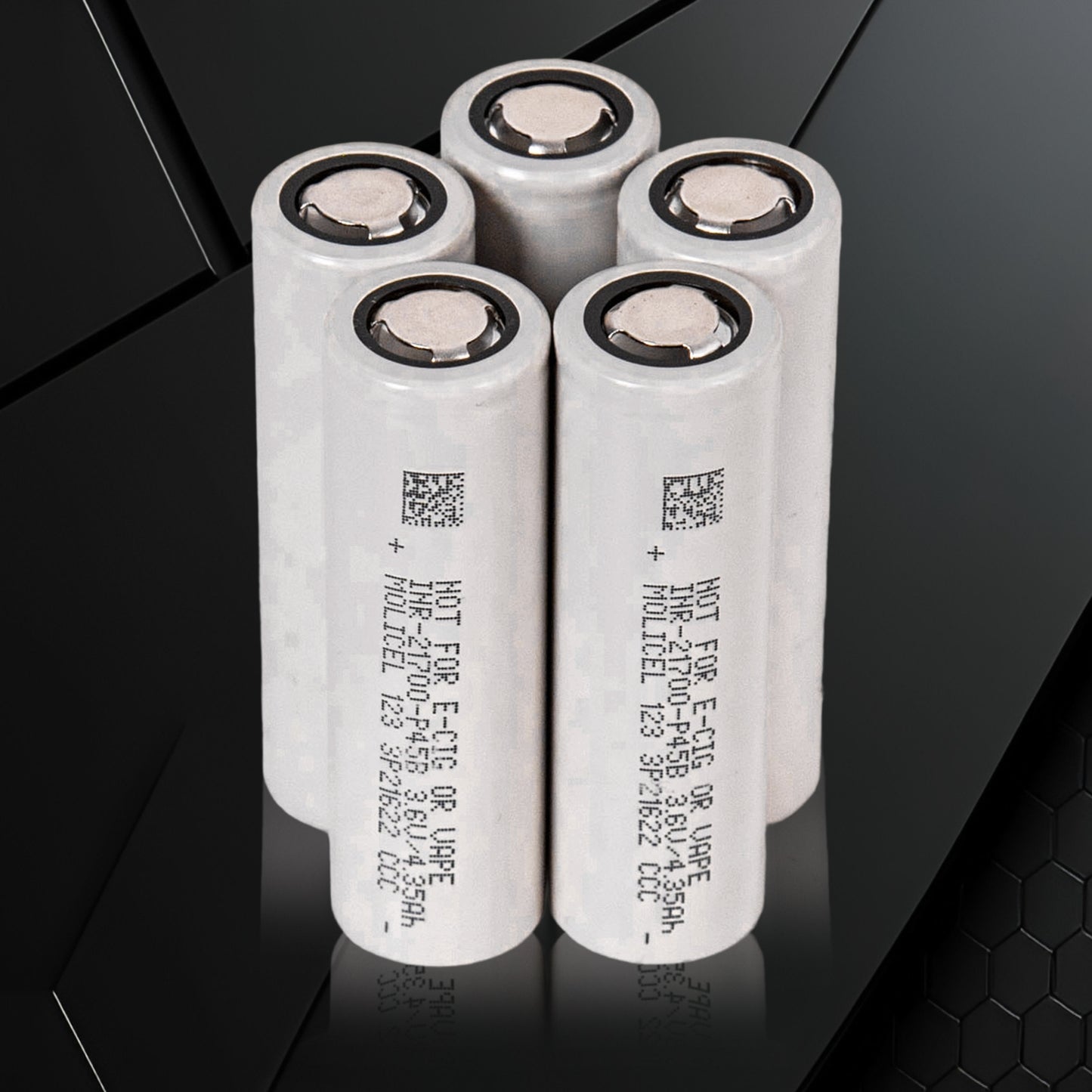
Cell Type: Lithium-ion rechargeable cylindrical cell (21700 format) Nominal Voltage: ~ 3.6 V Typical Capacity: ~ 4,500 mAh (4.5 Ah) Dimensions: Diameter max ~ 21.55 mm × Height max ~ 70.15 mm Weight: Max ~ 70 g
Max Discharge Current: ~ 45 A continuous (depending on conditions) Fast Charging Capability: Up to ~3C (≈ 13.5 A) proposed by manufacturer Energy Density: ~ 643 Wh/L (volumetric) and ~ 242 Wh/kg (gravimetric) Operating Temperature Range:
Implement over-current protection, since the cell supports very high current (45 A continuous).
Use voltage cutoffs: 4.2 V for charge, 2.5 V for discharge, per datasheet.
Incorporate temperature monitoring: because of high-current operation, cell surface temperature can rise quickly — a BMS with thermistor or temperature sensor is highly recommended.
How suitable is this cell for high-power applications?
Very suitable: it is designed for ultra-high power applications (e.g., EV, micro-mobility, high-drain tools).
The low internal resistance (DCIR) helps reduce voltage drop and heat under high loads.
With its high fast-charge capability (13.5 A), it can support systems that demand frequent or rapid charging cycles.
What are the mechanical and thermal considerations in a pack?
Because of its 21700 form factor, ensure your pack design accounts for its larger size and weight (≈70 g).
Thermal distribution is optimized in the cell (Molicel mentions a 3-4 °C thermal gradient).
Given the high discharge current, plan for efficient cooling or thermal paths in your pack to prevent overheating and ensure reliability.
What are the sourcing and quality assurance considerations?
Buy from authorized Molicel distributors to ensure access to genuine cells and current datasheets.
Request lot traceability, DCIR and capacity test data for batch verification — this helps you ensure consistency in your pack production.
Confirm transport safety documentation (e.g., UN38.3), especially for international or bulk shipping.
How does it compare to other cells in Molicel’s 21700 line (or competitors)?
Compared to lower-discharge cells like Molicel P42A (same 45 A spec but different IR/energy), P45B offers lower internal resistance and better power delivery.
Versus very high-capacity energy cells, P45B trades some absolute energy for better power performance.
Need the INR21700-P45B datasheet or more technical info? Send us a message below — we’ll reply within 24 hours.
Choosing a selection results in a full page refresh.