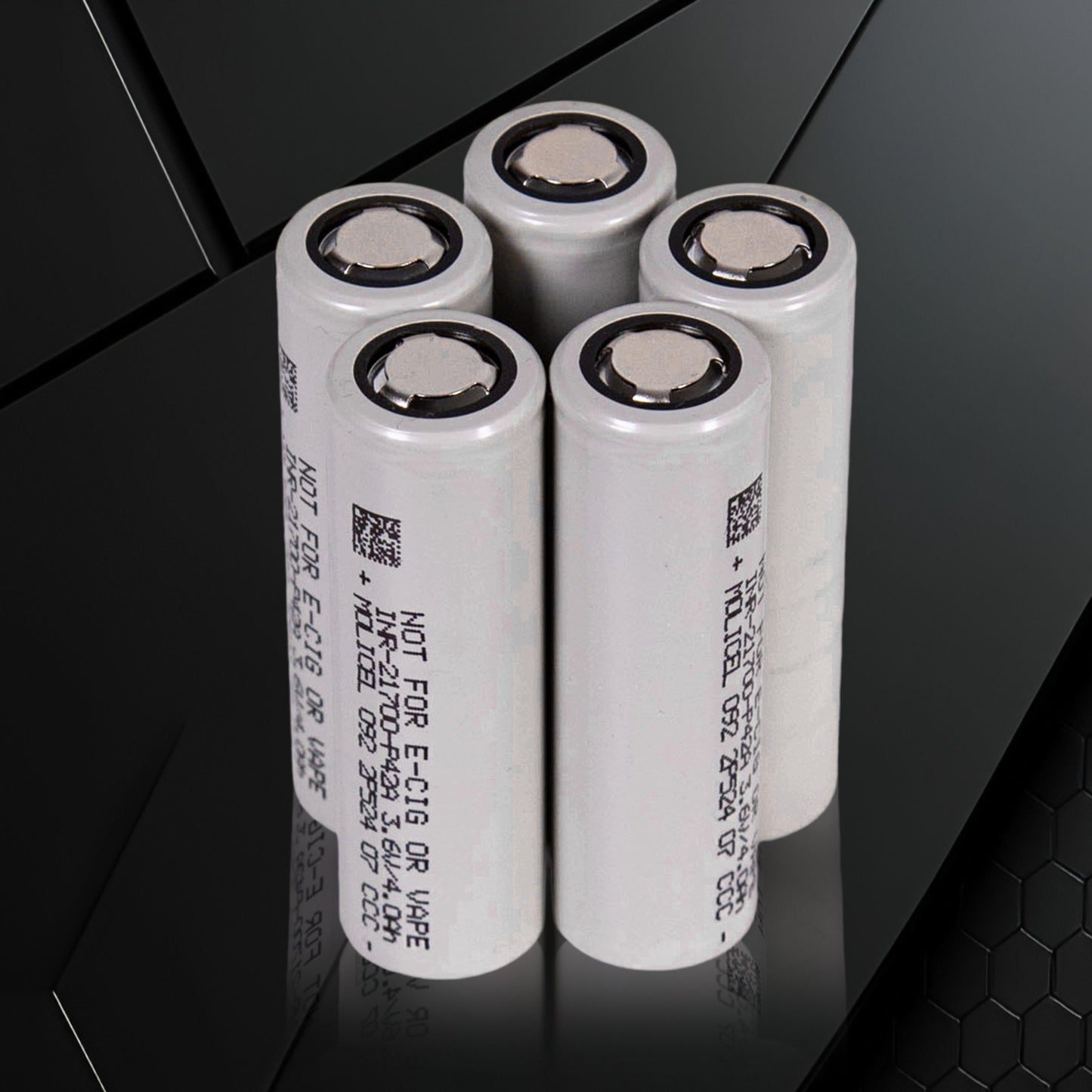
Cell Type: Lithium-ion rechargeable cylindrical cell (21700 format) Nominal Voltage: 3.6 V Typical Capacity: ~4,200 mAh (Minimum 4,000 mAh) Dimensions: Diameter ≤ 21.7 mm, Height ≤ 70.2 mm Weight (Max): ~70 g
Max Charge Voltage / Cut-off: 4.20 V (CC-CV typical) Discharge Cut-off Voltage: 2.50 V Max Continuous Discharge Current: ~45 A Operational Temperature Range:
Provide over-current protection: although datasheet says 45 A, this is a spec, not unlimited — design margin is important.
Include voltage cut-off protection: set over-voltage at ~4.2 V, under-voltage at ~2.5 V.
Include temperature monitoring: because of high discharge current, thermal rise must be managed (pack design should monitor cell temperature).
What is the expected cycle life and behavior?
While Molicel’s datasheet does not explicitly define “cycle life at 45 A,” third-party sources note good durability when used at moderate currents.
For B2B use, it's critical to define your cycle profile (DoD, current, temp) in test to validate lifetime for your use case.
What packaging / mechanical considerations should be made for pack design?
Because it’s a 21700 cell, consider the larger size and weight (~70 g) in your pack layout.
Ensure cell-to-cell matching (voltage and internal resistance) to maintain balance and safety in high-current designs.
Are there known user-reported limitations or trade-offs?
Some users note that running continuously at or near the maximum 45 A spec may cause thermal stress in real-world use. > “If you actually run at 45A continuously they get too hot.”
Peak or “burst” current above 45 A is not clearly defined in the datasheet; exceeding spec may hurt longevity. > “Running at … 50A or 60A … you will get … reduced cell life.”
Variability: some batches might have different internal resistance – recommend batch testing. > “Impedance … I have tested a few … the impedance is pretty bad … I don’t know … how is it possible …”
What are common application scenarios for this cell?
High-power tools, e-bikes, electric scooters, or other mobility applications that demand both power and energy.
Industrial or robotic systems where high discharge rate + stable performance is required.
Energy storage or backup systems that require both high current bursts and reasonable capacity.
Need the INR21700-P42A datasheet or more technical info? Send us a message below — we’ll reply within 24 hours.
Choosing a selection results in a full page refresh.